
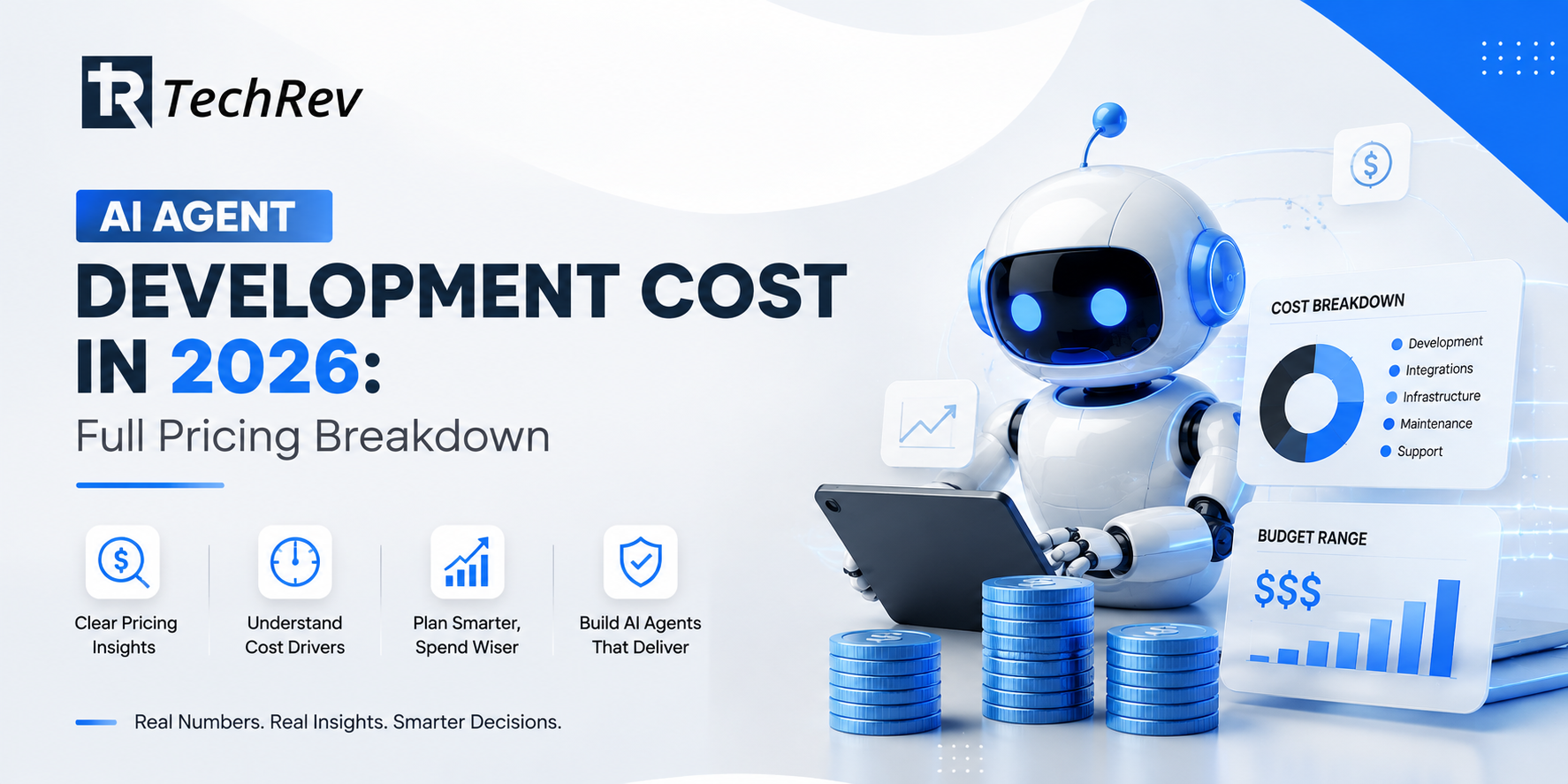
AI agent development cost is the question every automation conversation eventually lands on, and the honest answer has a shape, not a single number. A focused, well-scoped AI agent for one business workflow typically starts in the mid five figures; deeply integrated agents with compliance requirements run into six figures; and simple assistant-style builds on existing platforms can land below that range. What moves a project across those bands is not the AI model. It is scope, integrations, and governance.
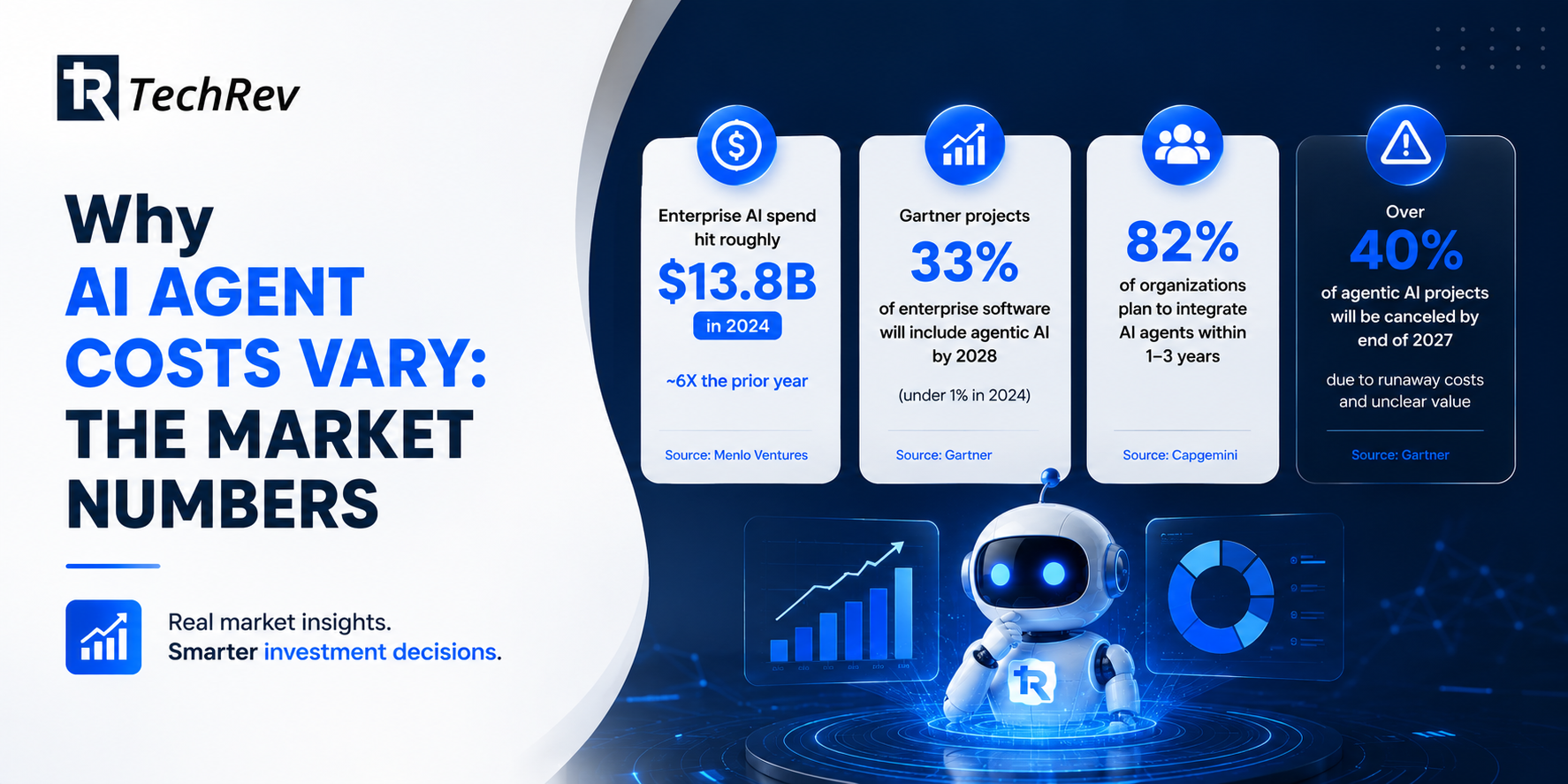
The money behind the question is real: Menlo Ventures’ widely cited research found enterprise generative AI spending hit roughly $13.8 billion in 2024, about 6x the prior year, and Capgemini found 82% of organizations planning to integrate AI agents within three years. Budgets are being set right now, and the buyers who understand the cost drivers negotiate better builds.
This guide breaks down AI agent development cost by agent type, the seven drivers that move pricing, the ongoing costs nobody quotes upfront, and the proven ways to cut the budget without cutting the outcome.
What Does AI Agent Development Cost in 2026?
AI agent development typically costs from the low tens of thousands of dollars for a focused, single-workflow agent using existing platforms and light integration, to mid five figures for a custom agent deeply integrated with business systems, to six figures for multi-agent deployments with compliance requirements, extensive integrations, and human-in-the-loop governance.
Ongoing costs, primarily model usage, hosting, and maintenance, commonly add 15 to 25% of the build cost annually.
Those ranges hold across the market because the underlying work is similar everywhere; what varies wildly is how much of it your project needs. The rest of this article shows you exactly where your project sits.
Why AI Agent Costs Vary: The Market Numbers!
Context first, because the market explains the pricing:
- Enterprise AI spend jumped ~6x to about $13.8 billion in 2024 per Menlo Ventures’ research, and agents are where an increasing share of that budget flows.
- Gartner projects 33% of enterprise software will include agentic AI by 2028 (under 1% in 2024), which is why development capacity is in demand and undifferentiated quotes vary so widely.
- 82% of organizations told Capgemini they intend to integrate AI agents within one to three years, meaning most buyers are pricing their first agent, without a baseline to compare against.
- The warning stat that should shape every budget: Gartner predicts over 40% of agentic AI projects will be canceled by end of 2027, driven by runaway costs and unclear value. Translation: the expensive failure mode is not overpaying for an agent. It is paying anything for the wrong one.
That last number is why this article spends as much time on scoping as on pricing. The cheapest AI agent is the one attached to a workflow with a measurable payback.
Also Read – Custom AI Agent Development: Process, Tech Stack, Timeline
AI Agent Development Cost by Type
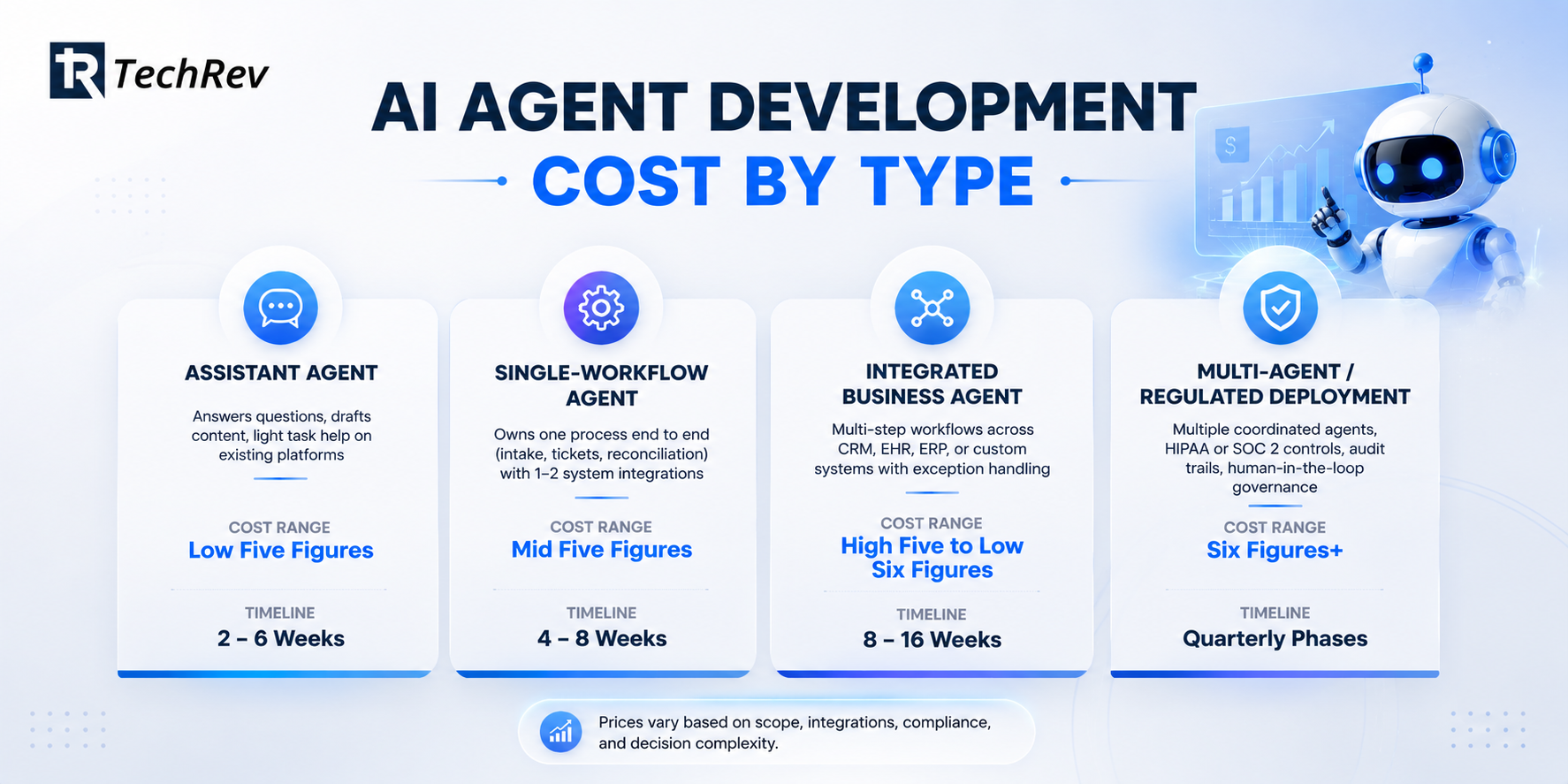
| Agent type | What it does? | Typical cost range | Timeline |
| Assistant agent | Answers questions, drafts content, light task help on existing platforms | Low five figures | 2 to 6 weeks |
| Single-workflow agent | Owns one process end to end (intake, tickets, reconciliation) with 1 to 2 system integrations | Mid five figures | 4 to 8 weeks |
| Integrated business agent | Multi-step workflows across CRM, EHR, ERP, or custom systems with exception handling | High five to low six figures | 8 to 16 weeks |
| Multi-agent / regulated deployment | Multiple coordinated agents, HIPAA or SOC 2 controls, audit trails, human-in-the-loop governance | Six figures, phased | Quarterly phases |
Two honest notes on the table. First, these are typical market ranges, not quotes; your integrations and compliance needs place you within them. Second, the jump between tiers is almost always integration and governance work, not “smarter AI,” which is exactly where the next section goes.
For a comparison point from a neighboring category, our live breakdown of chatbot app development cost shows how conversational-only builds price below agentic ones, because chatbots answer while agents act.
What Drives AI Agent Development Cost? The 7 Factors
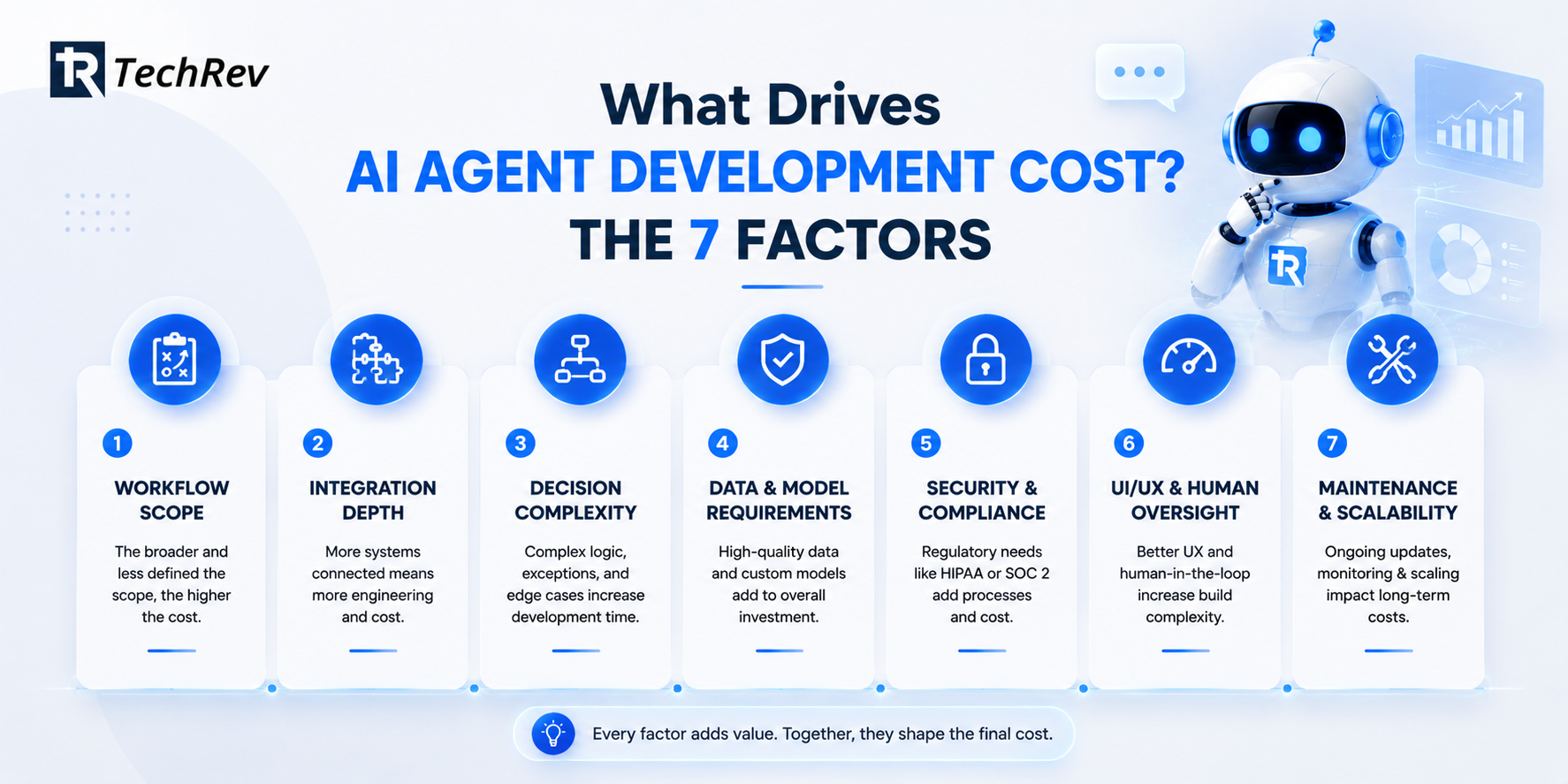
- Workflow scope. One process with clear rules costs a fraction of an open-ended assistant. The tightest scoping method we know is the four-factor filter from our guide to agentic AI use cases: volume, rules, system access, measurability.
- Integration depth. Each system the agent reads from or writes to (CRM, EHR, billing, scheduling) adds engineering. Integration typically consumes a third or more of the budget, and it is also where the value lives, since an agent that cannot touch your systems is a demo.
- Decision complexity. Simple routing is cheap; judgment within rules, exception handling, and multi-step planning add design and testing effort.
- Compliance requirements. HIPAA, SOC 2, and audit-grade logging add real architecture: encryption, role-based access, immutable trails, and BAA-covered services, commonly a 15 to 30% premium, and non-negotiable in regulated work.
- Human-in-the-loop design. Approval checkpoints, escalation paths, and override controls take deliberate engineering, and they are what makes agents deployable where mistakes cost money.
- Model and token economics. Which models the agent uses, and how efficiently, drives ongoing cost more than build cost. Well-engineered agents route routine steps to smaller, cheaper models and reserve premium models for hard reasoning.
- Maintenance and evaluation. Agents need monitoring, prompt and logic updates, and regression testing as models and business rules change; budget 15 to 25% of build cost annually.
Also Read – How to Build an AI Agent for Real Business Use?
How Much Do Ongoing LLM and API Costs Add?
For most single-workflow business agents, model usage lands in the hundreds of dollars per month at moderate volume, scaling with task count and complexity rather than seat count, one of the quiet economic advantages over per-user software pricing.
High-volume deployments engineer this down with model routing, caching, and batching. The number to demand from any developer: projected cost per completed task at your volume, not just a monthly estimate.
Custom AI Agent Development vs Off-the-Shelf Pricing
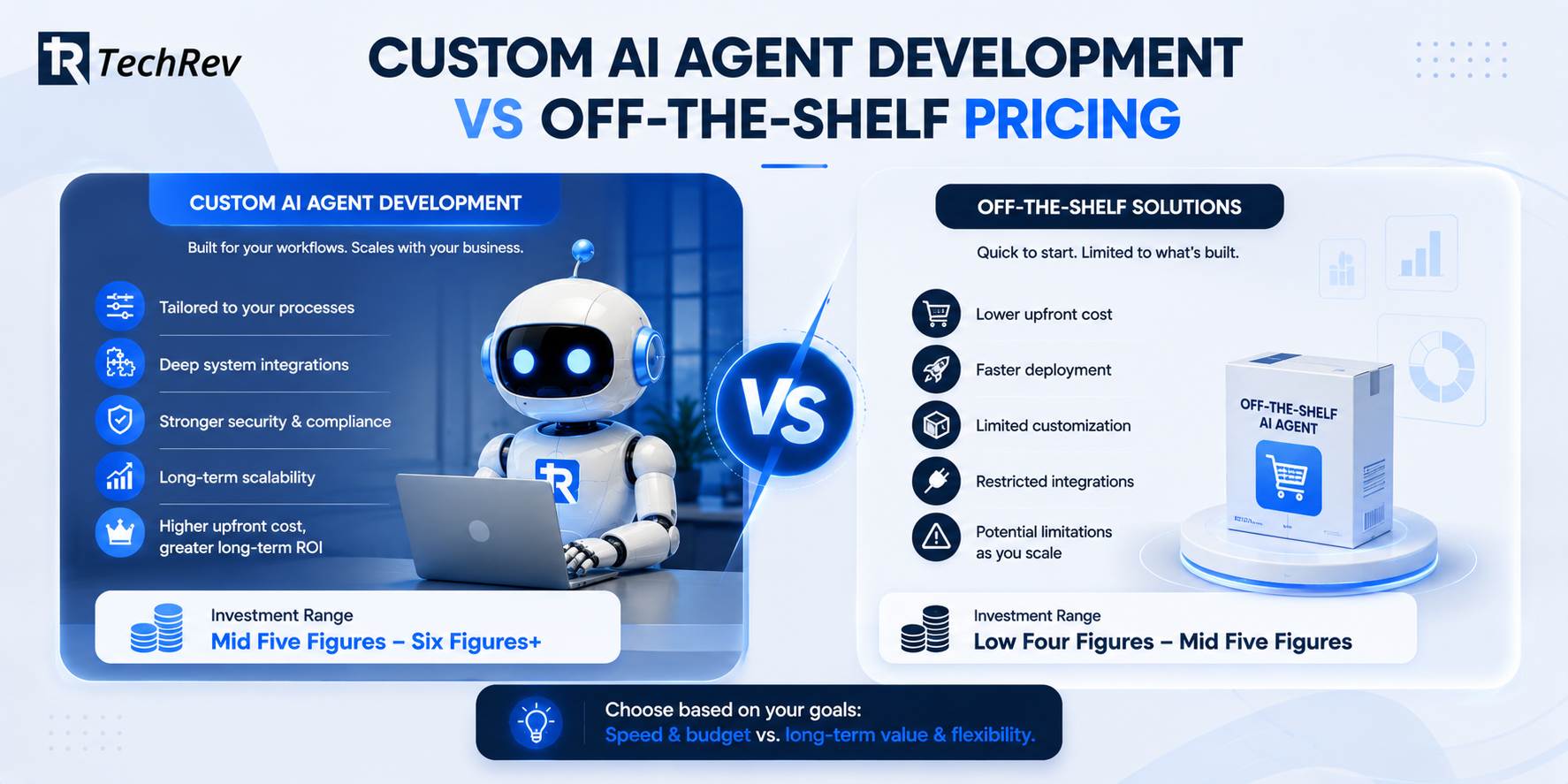
Off-the-shelf agent platforms and subscription tools price per seat, per task, or per conversation, which looks cheap at pilot volume and compounds forever, while custom AI agent development is a one-time build plus maintenance, with costs that flatten as volume grows.
The crossover typically arrives within one to two years for workflows with real volume, and sooner when integration depth or compliance forces workarounds in rented tools. We break the full rent-vs-own economics down in our comparison of AI automation agencies vs custom development.
The decision rule in one line: rent the standard workflows, own the ones that run your revenue or touch regulated data.
How to Reduce AI Agent Development Cost Without Killing the Project?
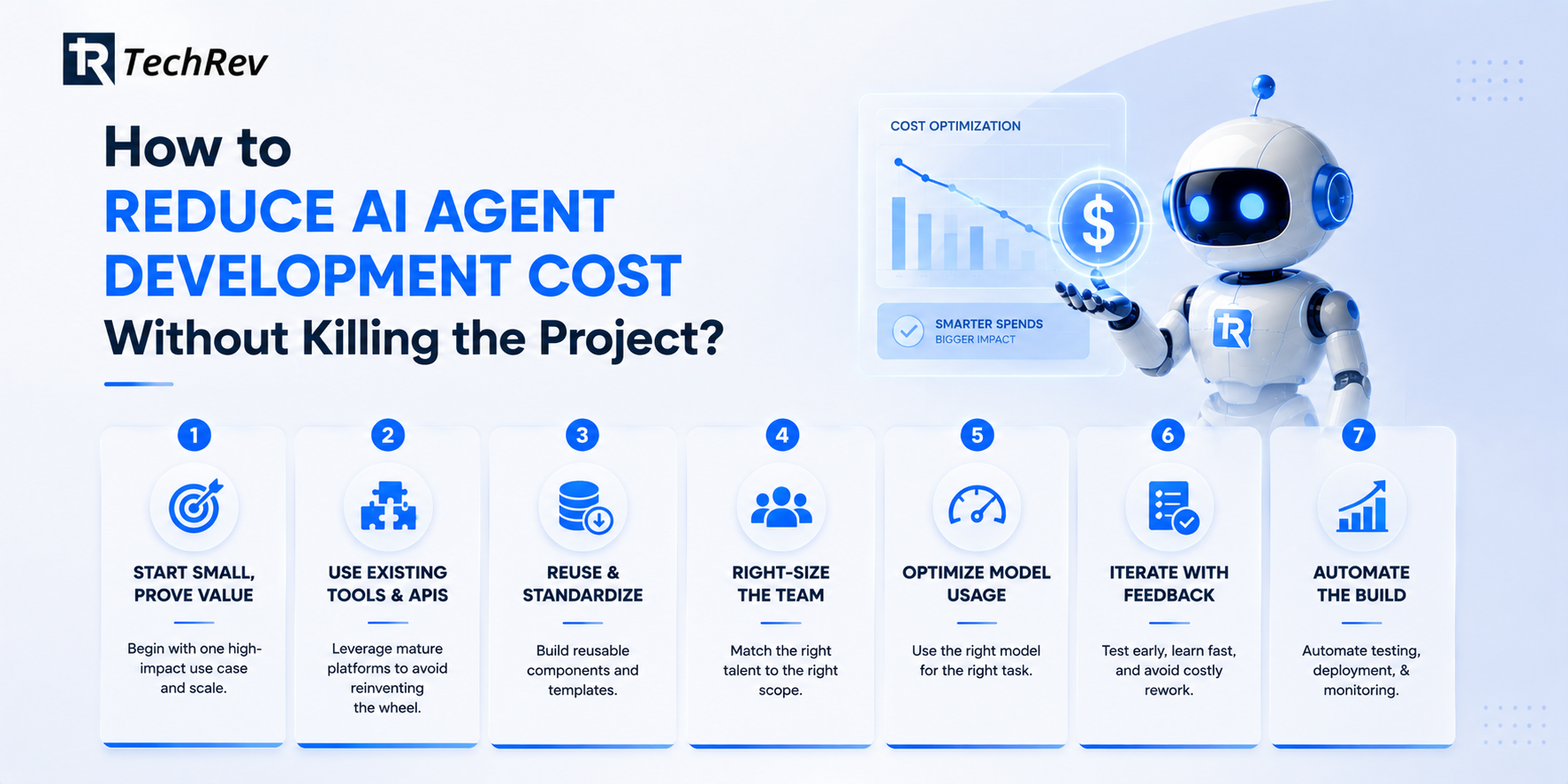
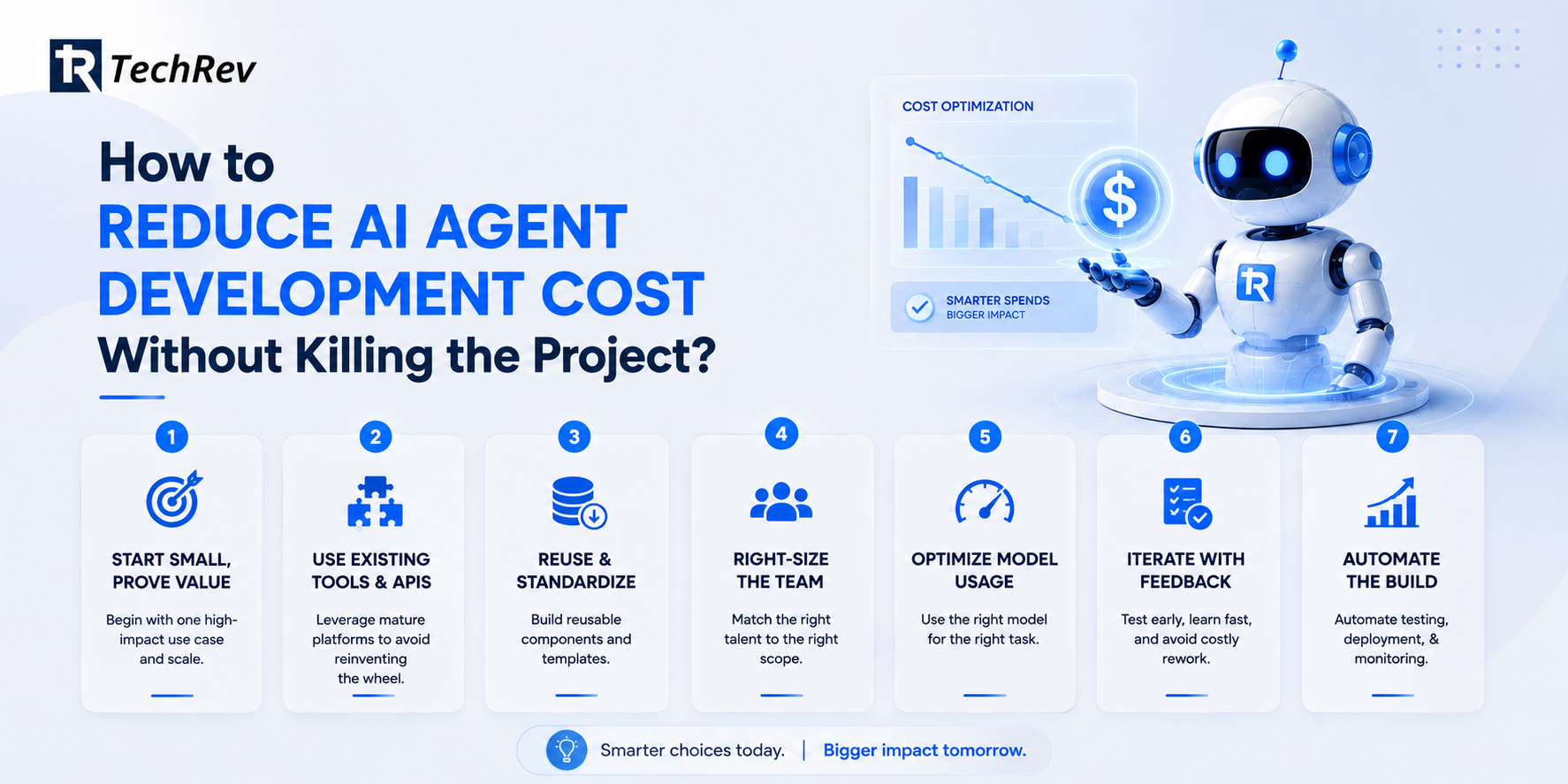
Five levers that cut budgets honestly:
- Scope one workflow, ruthlessly. The MVP development discipline applies perfectly: one agent, one metric, 90 days to prove it, then expand on evidence.
- Encapsulate instead of replacing. Agents layered on existing systems through APIs deliver automation without modernization budgets; where systems are genuinely blocking, see our legacy system modernization guide for the phased path.
- Reuse the governance layer. Access controls, logging, and escalation patterns built once serve every subsequent agent, which is why the second agent routinely costs far less than the first.
- Design the human checkpoints early. Retrofitting approval flows after launch is rework; designing them in is a line item.
- Demand per-task economics upfront. Model routing and caching decisions made at design time are cheap; made after launch, they are re-engineering.
What Hidden Costs Should You Budget For?
Four that surprise first-time buyers: data cleanup (agents expose every inconsistency your systems tolerated), evaluation and testing time (proving the agent safe takes structured effort), change management (staff need to trust the escalations), and model migration (models improve fast; a well-built agent swaps them without a rebuild, a cheap architecture decision that pays repeatedly).
How TechRev Prices AI Agent Development?
TechRev is a US-based AI agent development company delivering custom AI agent development services with integration-first architecture: agents built into the CRM, EHR, and operational systems businesses already run, priced by scoped phases with success metrics attached.
Q1: How does TechRev scope and price an AI agent project?
Transparently, in phases: a mapping session identifies the workflow with the strongest volume, rules, and metric; we quote phase one as a fixed scope with the success numbers written in (tickets resolved, hours saved, error rates); and ongoing costs are projected as cost per completed task at your volume, including model routing decisions, before you sign.
Compliance-grade builds carry the governance premium openly (encryption, audit trails, human-in-the-loop controls), because that is what makes agents deployable in HIPAA and SOC 2 environments. The second agent inherits the first one’s architecture, which is why our clients’ cost per workflow drops with each phase.
Q2: What does a first AI agent project with TechRev typically cost?
Phase-one single-workflow agents typically land in the mid five figures depending on integrations and compliance needs, with the scope, metrics, and per-task economics fixed in writing upfront.
Q3: Does TechRev charge per seat or per task?
Neither. You own the software TechRev builds; ongoing costs are hosting, model usage, and maintenance, projected per completed task at your volume before the build starts.
Q4: What results has TechRev delivered with agent-driven automation?
For a hospital services vendor, TechRev’s AI-powered workflow and tracking system cut installation errors by 90% and recovered billing evidence manual processes kept losing.
Conclusion
Enterprise AI budgets grew 6x in a year, 82% of organizations are heading into agents, and 40% of those projects are predicted to fail on cost and unclear value. The difference between the two groups is not spend; it is scoping. Priced correctly, an AI agent is a five-figure build against a six-figure-a-year workflow problem, with economics that improve every phase after.
If you want a number for your workflow instead of a range in an article, talk to TechRev’s AI team. We will map the workflow, fix the success metrics, and give you phase-one pricing with per-task economics in writing, so the budget conversation starts with facts.
FAQs
1. How much does it cost to build an AI agent?
From the low tens of thousands for assistant-style builds, mid five figures for a custom single-workflow agent with integrations, and six figures for multi-agent or regulated deployments. Scope, integration depth, and governance requirements decide the band; the model itself rarely does.
2. What is the monthly cost of running an AI agent?
Plan for model usage (often hundreds of dollars monthly for single-workflow agents at moderate volume), hosting, and maintenance totaling roughly 15 to 25% of build cost annually. Insist on projected cost per completed task, the metric that makes offers comparable.
3. Why do AI agent development quotes vary so much?
Because “agent” spans everything from a prompt wrapper to a governed multi-system worker. Quotes diverge on integration depth, exception handling, compliance architecture, and whether per-task economics were engineered. Comparable quotes require a written scope: workflow, systems, checkpoints, metrics.
4. Is AI agent development worth it for small businesses?
Yes, when one workflow costs more than one salary per year in labor or errors; a scoped agent usually pays back within the first year. Below that threshold, off-the-shelf tools are the rational start, and the honest developer will tell you so.
5. How long does AI agent development take?
Assistant builds: 2 to 6 weeks. Single-workflow custom agents: 4 to 8 weeks. Integrated business agents: 8 to 16 weeks. Regulated multi-agent programs run in quarterly phases by design, each phase gated by its metrics.
6. What should be included in an AI agent development services quote?
Written workflow scope, named system integrations, human-in-the-loop design, compliance controls where applicable, success metrics with measurement plan, projected per-task running costs, and the maintenance model. A quote missing half of these is not cheaper; it is unfinished.