

The Dart vs JavaScript debate is one of the biggest decisions you will make before starting mobile app development in 2026, because this single choice shapes your app’s performance, hiring costs, and how painful (or painless) maintenance feels two years down the road.
Get it right, and your product scales smoothly. Get it wrong, and you may end up rewriting core features when your user base grows.
So which one deserves your budget? Let’s break down Dart vs JavaScript with real market data, real apps, and real numbers, not opinions.
Dart vs JavaScript: Quick Comparison
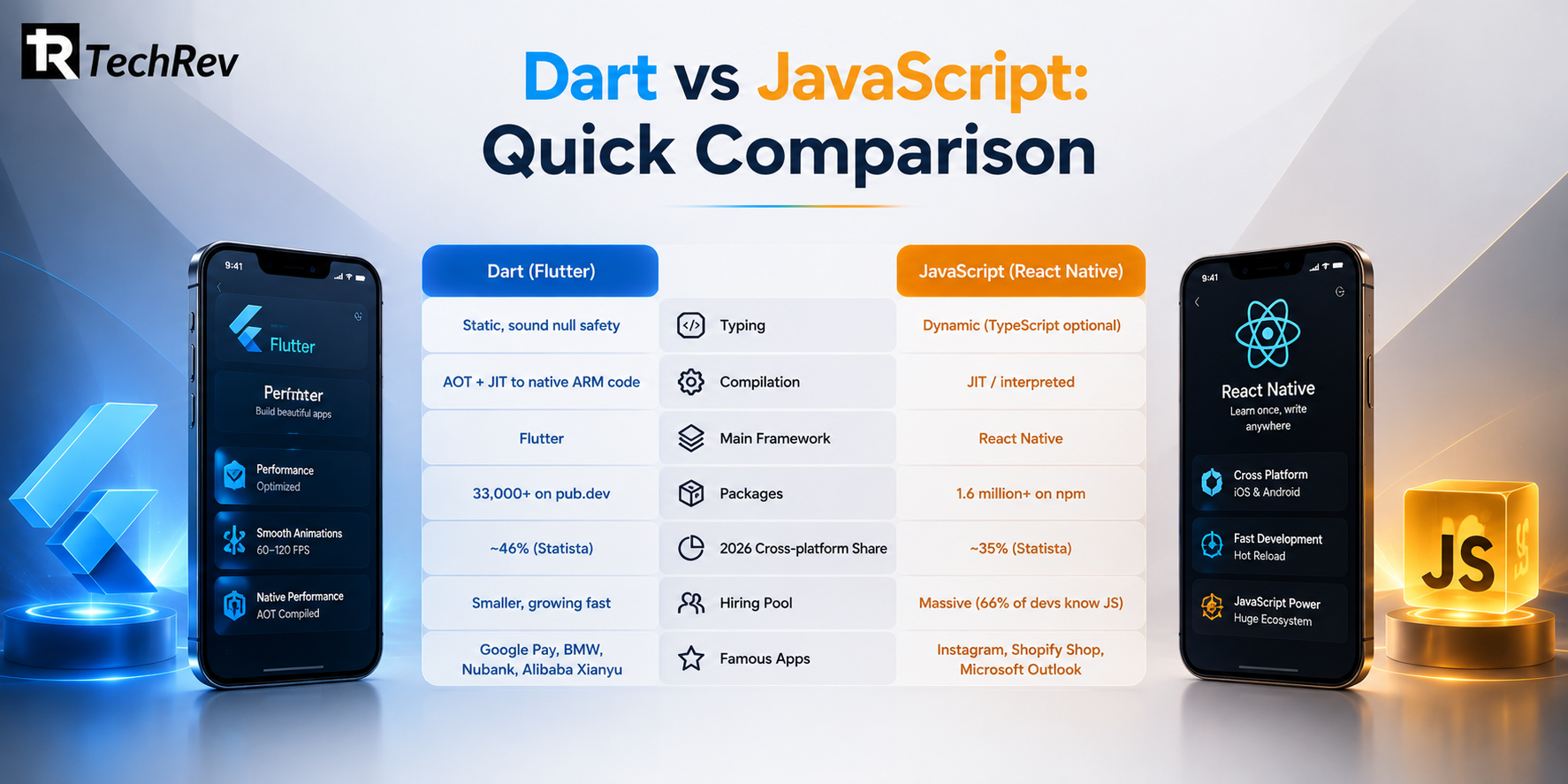
| Factor | Dart (Flutter) | JavaScript (React Native) |
| Typing | Static, sound null safety | Dynamic (TypeScript optional) |
| Compilation | AOT + JIT to native ARM code | JIT / interpreted |
| Main framework | Flutter | React Native |
| Packages | 33,000+ on pub.dev | 1.6 million+ on npm |
| 2026 cross-platform share | ~46% (Statista) | ~35% (Statista) |
| Hiring pool | Smaller, growing fast | Massive (66% of devs know JS) |
| Famous apps | Google Pay, BMW, Nubank, Alibaba Xianyu | Instagram, Shopify Shop, Microsoft Outlook |
What Is Dart, and Why Do Developers Suddenly Care?
Dart is Google’s programming language built for fast, structured, type-safe development, and it powers Flutter, the framework behind some of the world’s largest apps. Nubank, Latin America’s biggest digital bank with 90 million plus customers, runs on it. So does Alibaba’s Xianyu marketplace with over 200 million users.
That is not a hobby language anymore. That is enterprise-grade Flutter app development at massive scale.
What Makes JavaScript So Hard to Beat?
JavaScript is the most used programming language on the planet. According to the Stack Overflow 2025 Developer Survey, around 66% of developers work with it. It powers the web, the backend (Node.js), and React Native app development for mobile. If you can hire fast and reuse web code, JavaScript wins on convenience every single time.
Also Read – Swift vs Kotlin: Native App Development Compared (2026 Guide)
Dart vs JavaScript: 5 Differences That Actually Matter
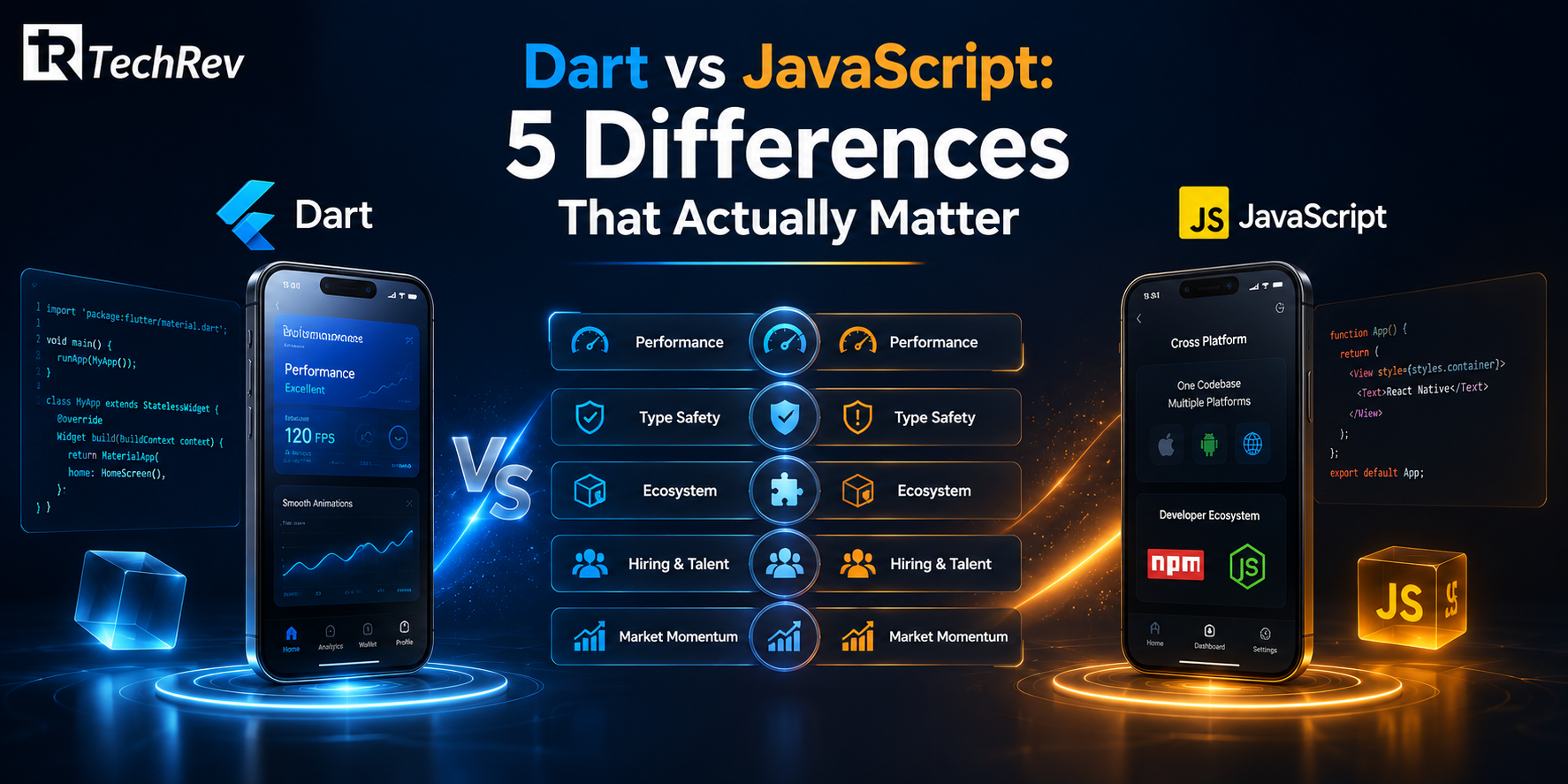
The following are the key differences:
1. Performance: Compiled vs Interpreted
Dart compiles ahead of time (AOT) into native ARM machine code, so Flutter apps run directly on the device with no bridge in the critical path. That is why Flutter delivers consistent 60 to 120 FPS animations, which matters for fintech dashboards, games, and animation-heavy interfaces.
JavaScript runs through an engine at runtime. React Native’s New Architecture (Fabric, JSI, TurboModules) has closed most of the old performance gap, and for roughly 90% of typical business apps, users will never notice a difference. But at the extreme end, Dart still holds the edge.
2. Type Safety: Fewer Crashes in Production
Dart enforces sound null safety at compile time. Entire categories of null-pointer crashes simply cannot ship. JavaScript is dynamically typed, so those errors surface at runtime, sometimes on a paying customer’s phone. TypeScript helps, but it is optional discipline, not a language guarantee.
Why does this matter for your business?
Because a crash in a checkout or payment screen does not just annoy users, it kills trust and conversions. For healthcare, fintech, and eCommerce products, compile-time safety is a genuine revenue protector.
3. Ecosystem: 1.6 Million Packages vs 33,000
Here JavaScript dominates. npm hosts over 1.6 million packages, while Dart’s pub.dev has around 33,000. The catch? Pub.dev covers virtually every mainstream mobile need (Firebase, Stripe, Google Maps, push notifications, biometrics) with fewer dependency conflicts. npm wins at the edges: niche integrations, legacy enterprise APIs, and specialized tooling.
4. Hiring and Cost
This is where the Dart vs JavaScript decision hits your wallet. React Native has roughly 6x more job postings in the US market, and the JavaScript talent pool is 3 to 5 times deeper, which usually means faster and cheaper hiring.
Dart developers are rarer, though demand for Flutter app development roles is growing faster year over year.
5. Market Momentum in 2026
The numbers tell an interesting story. Per Statista’s 2026 data, Flutter now holds about 46% of the cross platform app development market, while React Native holds about 35%.
Together they power over 80% of all cross-platform apps, in a market that reached an estimated 25.6 billion dollars in 2026. Translation: neither language is going anywhere, and both are safe long-term bets.
Is Dart Better Than JavaScript for Mobile App Development?

Short answer: Dart is better when performance, pixel-perfect UI, and long-term code maintainability top your priority list. JavaScript is better when speed to market, easy hiring, and code reuse across web and mobile matter more. Neither is universally “better,” which is exactly why an experienced mobile app development company will ask about your roadmap before recommending a stack.
Choose Dart (Flutter) if:
- Your app needs complex, custom UI and heavy animations
- You want one codebase that looks identical on iOS and Android
- You are building a long-term product where refactoring safety pays off
- Compile-time error catching matters (fintech, healthtech, eCommerce)
Choose JavaScript (React Native) if:
- Your team already knows React or JavaScript
- You need to hire quickly and affordably
- You want to share logic between your web app and mobile app
- You are shipping an MVP and speed beats polish
Also Read – In-House Developers vs Mobile App Development Agency
What Happens 6 Months After Launch?
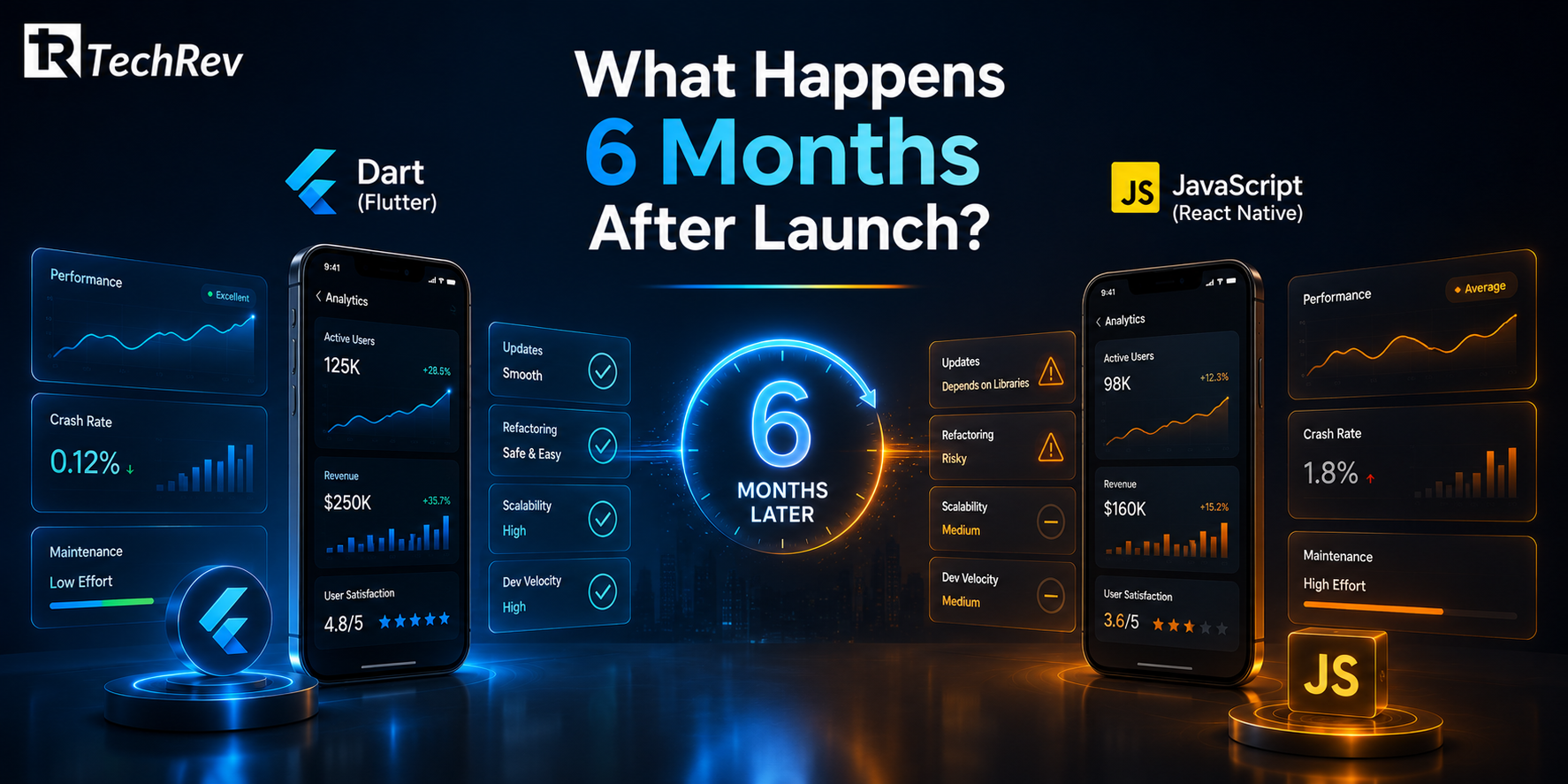
Choosing a language is not just about the build phase. It is about the maintenance bill.
In JavaScript projects, dynamic typing means production bugs can be harder to trace, and every major iOS or Android release can require waiting on framework updates because React Native depends on native components.
In Dart, refactoring is safer since the compiler flags every affected line instantly, and Flutter’s own rendering engine makes OS updates less disruptive.
For growing products, there are different compounds. Both cross platform app development frameworks save 30 to 60% compared to building separate native iOS and Android apps, but disciplined architecture decides whether those savings survive year two.
How TechRev Helps You Win the Dart vs JavaScript Decision?
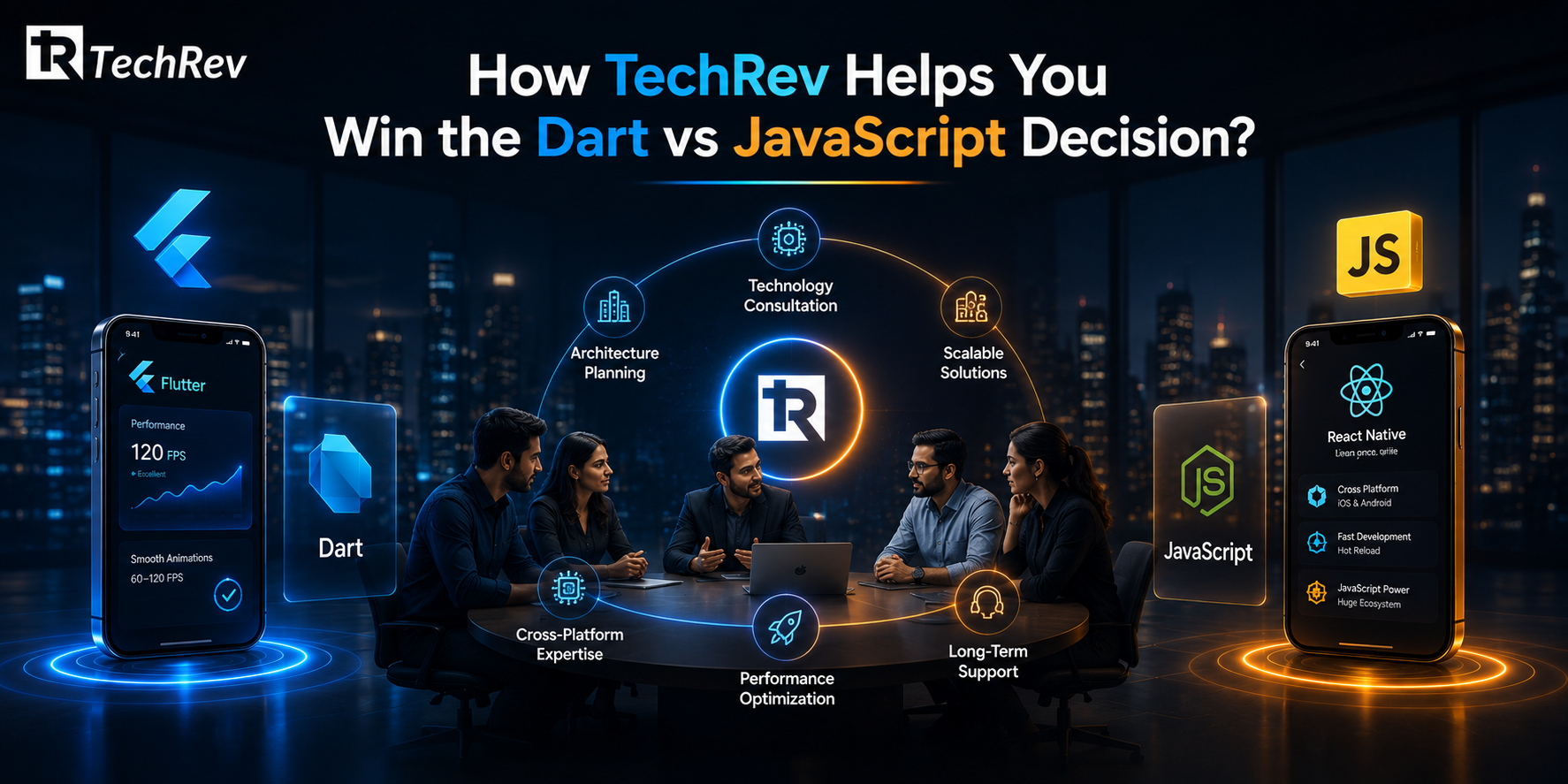
Reading comparisons is useful. Getting it built right is what actually grows your business. That is where TechRev comes in.
TechRev is a USA-based mobile app development company, delivering custom mobile app development, AI-powered software, and cross platform app development for businesses since 2016. Whether your product calls for Flutter app development or React Native app development, TechRev’s team helps you pick the stack based on your data, not hype.
What do you actually get with TechRev?
- Lower total cost: One shared codebase instead of two native teams, cutting development spend significantly versus separate iOS and Android builds. Projects start from as little as $5,000, with transparent quotes before any work begins.
- Faster launch: A basic app in as little as 4 to 8 weeks, and complex AI-powered platforms in 3 to 6 months, with a clear timeline from day one.
- AI built in, not bolted on: From chatbots and predictive analytics to recommendation engines, TechRev integrates AI features into new or existing apps so your product ships smarter than the competition.
- Post-launch peace of mind: Bug fixes, performance optimization, security updates, and feature enhancements after release, so your app stays fast and reliable.
- Flexible engagement: Need extra hands instead of a full build? Hire dedicated developers who plug straight into your existing team.
Can TechRev help if I have already started my app in another framework? Yes. TechRev works with existing codebases, audits your current architecture, and recommends whether to optimize, extend, or migrate, always with cost and timeline clarity first.
Also Read – Top 15 Mobile App Development Challenges in 2026
Conclusion
There is no single winner in the Dart vs JavaScript battle, only the right fit for your product. Dart delivers structure, safety, and stunning UI consistency. JavaScript delivers speed, flexibility, and the world’s largest developer ecosystem. In 2026, both are mature, both are backed by tech giants, and both power apps used by hundreds of millions of people.
The smartest move? Match the language to your roadmap, your team, and your budget. And if you want experts to handle that decision (and everything after it), talk to TechRev today for a free consultation. Your idea deserves more than a coin flip.
FAQs
1. Can Dart replace JavaScript?
Not on the web, where JavaScript runs natively in every browser. But in mobile app development, Dart with Flutter already competes head-to-head with JavaScript, and in cross-platform market share it has pulled ahead.
2. Which is faster, Dart or JavaScript?
Dart is generally faster for mobile UIs because it compiles ahead of time to native machine code. JavaScript with React Native’s New Architecture is close behind, and for most standard business apps the difference is barely noticeable.
3. Is Dart harder to learn than JavaScript?
Slightly, if you are new to static typing. But for developers coming from Java, C#, or TypeScript, Dart often feels cleaner and more predictable than JavaScript.
4. Which is better for startups in 2026?
JavaScript usually wins for MVPs thanks to faster hiring and rapid prototyping. Dart suits startups betting on long-term scalability and a highly polished UI. Many founders let a mobile app development company evaluate both against their roadmap before committing.
5. What types of apps does TechRev build?
TechRev builds Android, iOS, and cross-platform mobile apps, web applications, enterprise software, AI-powered tools, eCommerce platforms, and on-demand service apps.
6. How much does app development cost at TechRev?
Simple apps start around $5,000, while enterprise or AI-driven builds may cost $25,000 or more. You get a detailed quote after a free consultation.
7. Does TechRev provide support after launch?
Yes. TechRev offers ongoing maintenance, security updates, performance optimization, and new feature rollouts after your app goes live.